
BY KENNETH M. KAPP
PhD 1967 UNIVERSITY OF WISCONSIN
September 12, 2025
When I was a little boy, my mother told me that the ancient sampler hanging behind the
“company” couch in our living room was stitched by my great grandmother over 100 years ago. I was born in 2002 and after visiting the old homestead in the mountains when I was 12, figured out that it was most likely made around WWII. It was old but not that old!
I could see why it meant so much to our family: “A GOOD BOOK IS A BETTER
FRIEND.” I mean, if Mom’s grandparents were dumb and didn’t have any book-learning most likely we’d still be out in the boonies – or just our bones. Only weeds like it there and rot does well, especially in the holler where they had the old homestead. Mostly you can find some rocks knocked down from the hearth.
Mom said I was named after my great grandfather Steven and that at the end of every
decade the sampler goes to the oldest college graduate in that decade and then that person gets to keep it for the next ten years. It means the best chance of winning is if you drop out and then go back to college and graduate later. That’s how Mom got it in 2010. She had us kids and then went back to finish her college degree. She’s a teacher now and you better believe it – I have to do all my homework. No excuses.
When I was a junior in high school we had to write an essay about our family. Mom was
willing to help with the history, but I wrote it myself, deciding it was best told like a fairy tale.
~ * ~
A long time ago, nestled in a holler of the Appalachian Mountains lived a poor farmer
and his family. He worked long hard hours, eking out a living from the rocky land. And when he wasn’t bent over the ground with his hoe, he’d straighten his back and take to the woods, hoping to find something in his traps. He didn’t have anything against squirrels or rabbits, but he had hungry mouths to feed. He’d carry his rifle along in case he stumbled on a deer but worried that he wouldn’t be able to pull the trigger because of their big brown eyes.
His stomach was always growling, and he didn’t need reminding from his wife or her
advice to plant this or that. The soil didn’t like any of the grains he tried, and the birds and animals got most of whatever stunted corn got past the first frost. Root crops fared better. So, he planted a few rows of potatoes, a couple of turnips, and a few more rows of carrots and parsnips. He saved one corner for horseradish. On the rocky slopes facing south he planted pumpkins, squash, and cucumbers. At the ends of his rows, he’d set onions and garlic, hoping this would discourage varmints from exploring further.
His wife had chided him, “Horseradish? Do you think that will attract a horse? One that
will come prancing up the hill, take a bite and decide to stay? And then you can spend all day giving the children horse rides! You’d have better luck with mule-root. It’s stubborn just like you.”
However, remembering the old country and the sweet smell of dill bread from his
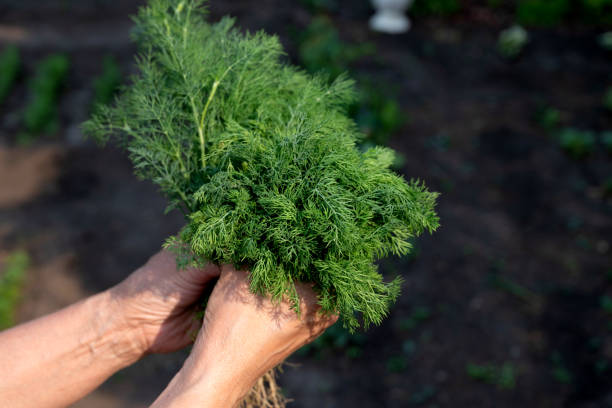
mother’s oven, one year he planted dill. And with this he had some success. The seeds spread by themselves to all corners of the farm. In the fall the oldest children would pull up the plants, hanging them upside down in the small shed behind their house.
You make do with what you have. Using onions, garlic, and horseradish they’d pickle
what they could. His wife had a magic touch and knew exactly when to throw vegetables in the barrel and when to fish them out. She did concede that it was the dill that did the trick. “And maybe the horseradish leaves keep them crisp.”
They were able to barter her pickles and his dill seed for most of what they needed,
sometimes earning a quarter here or a dollar there. The farmer rarely complained, only remarking now and then that life was hard, “But we’re getting by.” His wife was always too tired to argue.
Both agreed that they wanted a better life for their children. “Book-learning is what they need,” he’d say at least once a week. On a square of cloth cut from an old sack with bits of thread she stitched: “A GOOD BOOK IS A BETTER FRIEND.” When they could, they got the children off to the one-room schoolhouse in the next valley. But it was a long trek, and the children were never there when the school bell rang.
Their classmates were not kind and often taunted them, chanting: “Your father’s a diller
who can’t make a dollar, and you live down in the holler and don’t get here ‘til noon.”
The farmer’s children worked hard and were successful, moving into the big city. They
instilled the value of a good education in their own children, often reciting the taunt hurled at them when they were in school but shortened:
A diller in a holler, a ten-dollar scholar.
When their parents became too old to work on the farm, the children relocated them to a small cottage on the outskirts of the city. On weekends one or another family would come for lunch with the grandchildren. Eventually the grandchildren were old enough to come by themselves on Sunday morning and would sit at the kitchen table doing their homework.
When the church bells rang at noon their grandmother served milk and cookies and
reminded them to work hard in school. And they all did.
~ * ~
My teacher really liked my essay but didn’t believe it was true until I showed her a
picture of my great grandma’s tombstone back on the old homestead where every five years we have a family reunion. You could still read the chiseled letters: “diller dollars for scholars.” Mom said her mother told her it was a hard life, but they all kept their sense of humor.


Leave a Reply